
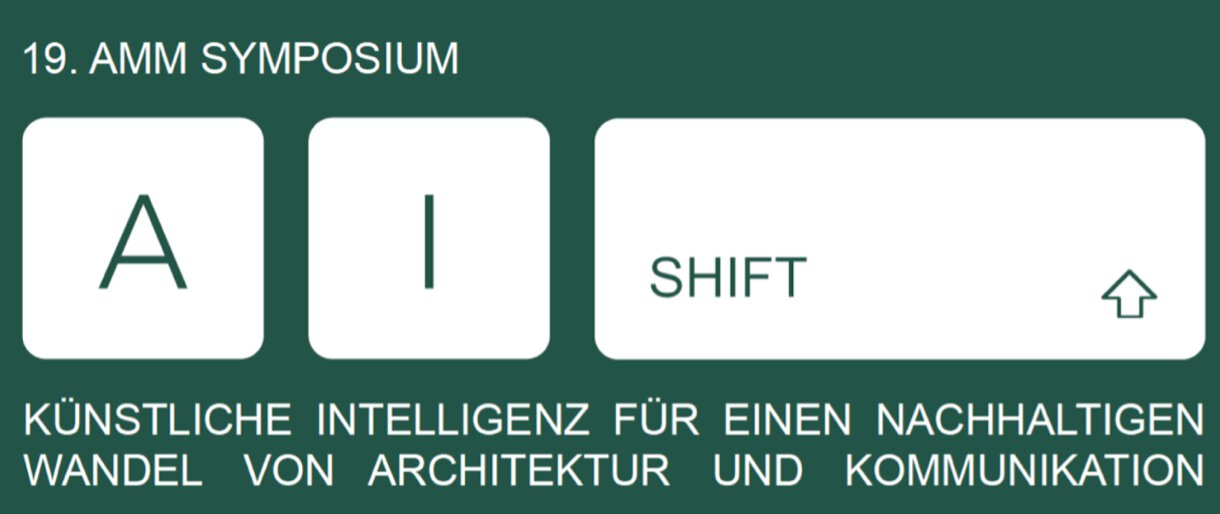
AI SHIFT—Artificial Intelligence for Sustainable Change in Architecture and Communication?

From Experiment to Application: AI has the potential to enter real planning processes. A conversation with Prof. Jan R. Krause and students of the AMM master’s program ahead of the 19th AMM Symposium on April 10 in Bochum.
Not if, but how: AI as a tool for sustainable planning and communication
Since 2024, the Architecture Media Management Master’s Program at Bochum University of Applied Sciences has hosted an annual conference on Artificial Intelligence in architecture. In the first year, the focus was on practical applications in design, cost estimation, and marketing. In 2025, legal issues, data ethics, and sustainability moved further into the spotlight. For 2026, the focus is shifting again. Discussions will address not only how AI can support sustainable planning—for example in material evaluation or CO₂ accounting—but also what resources the use of these systems themselves requires.
The question is no longer whether planning offices will work with artificial intelligence, but how they will deal with it. In conversation with Prof. Jan R. Krause and students from the Architecture Media Management master’s program, it becomes clear that the issue is no longer a fundamental decision for or against AI, but rather its professionally responsible use. Krause describes the shift in the planning process as follows: “We are no longer searching, we are finding—and must verify what we find.” In the past, analysis came at the beginning of a project. Today, systems can generate designs, variants, or initial evaluation metrics based on just a few parameters. Verification follows afterwards. What matters most is not the availability of these systems but the interpretation of their results. Anyone who does not understand how a model was trained and what assumptions are embedded in the data can hardly assess the quality of the results. This changes the role of planners, as “their own analysis–research–evaluation process is suddenly shifted downstream.” They must first define objectives, develop criteria, and formulate questions in order to subsequently evaluate the generated proposals professionally. In this context, Krause sees AI not merely as another digital tool like CAD or BIM, but as a “sparring partner” that must be trained like a new member of staff.
The development curve is steep
In conversation, it also becomes clear how quickly the discourse has shifted. Three years ago, AI image generation was at the center of attention. People experimented and explored possibilities to challenge the systems. Today, the focus has changed. AI becomes particularly relevant where it intervenes in project phases that have long been considered especially time-consuming. These include cost estimation, sustainability assessment, and compliance checks with standards and building regulations. When design decisions can already be tested at an early stage against their financial or ecological impacts—based on a large number of variants—the planning logic itself begins to change. This increases the responsibility to apply these figures correctly within complex decision-making processes. After all, a metric cannot replace professional judgment or experience. At the same time, there are interesting technological developments in Germany from startups working on AI for sustainability, as the AMM students discovered in their research.
For small and medium-sized offices, this development is ambivalent. AI promises efficiency, yet there is often little time for a structured implementation. In the discussion, the term overload appears repeatedly. Against this backdrop, the symposia are seen as a source of orientation—an opportunity to discuss opportunities and limits in a concentrated way. Inevitably, the conversation also touches on the question of sustainability. Not only in terms of sustainable buildings, but also sustainable processes. While leftover materials are sorted and reused in design studios, computation-intensive systems consume significant energy resources.
19th AMM Symposium “AI SHIFT” at Bochum University of Applied Sciences
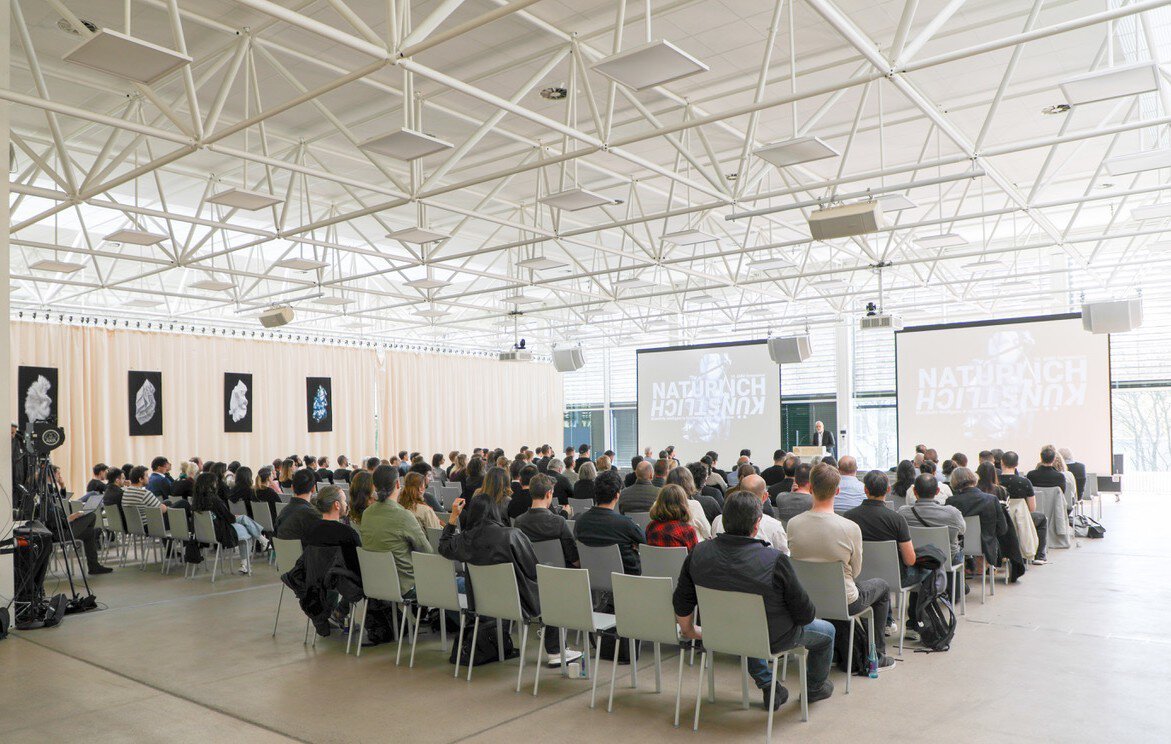
The 19th AMM Symposium addresses this development. Under the title “AI SHIFT”, on April 10 at the Bluebox Bochum, discussions will explore how AI can be integrated into design and evaluation processes—and where its limits lie. The program covers key topics shaping the AI discourse in architecture today. Representatives from chambers, architectural institutions, and trade media will discuss how the profession is changing under digital conditions and how widely AI applications are used in architectural offices. Another focus is on sustainable design strategies. Experts from research and practice will demonstrate how AI supports resource-efficient building concepts—from new construction to existing building adaptation. International architectural firms provide insights into data-driven design processes and their organizational integration. The question of energy consumption of AI systems themselves is also part of the discussion. The lecture program is complemented by workshops in the AI Lab at Bluebox, showcasing applications for cost estimation, sustainability assessment, and visualization.
The conference, held hybrid (in-person and online), is organized as a real-world lab by students of the Master’s Program in Architecture Media Management AMM under Prof. Jan R. Krause. The symposium is registered as a continuing education event with the Architects’ Chamber NRW. Participation is free.